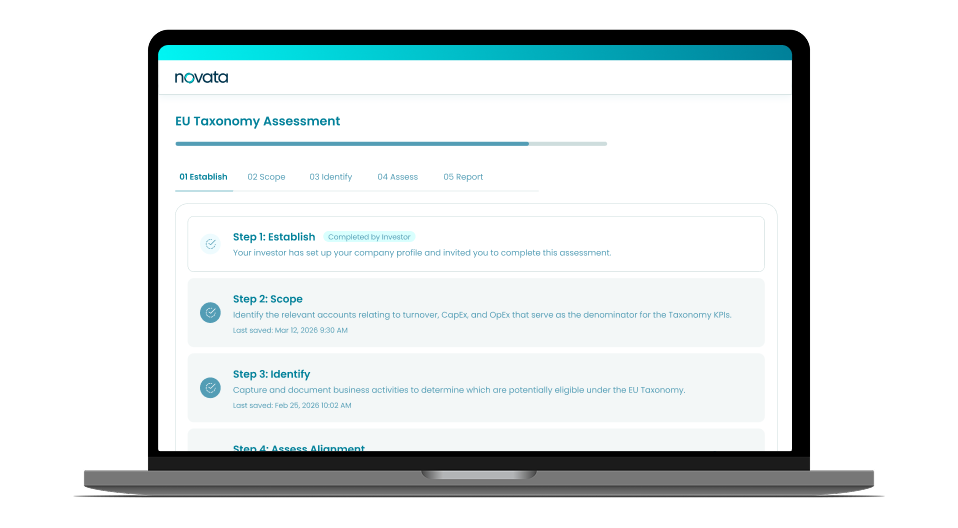
Assessing EU Taxonomy eligibility and alignment is complex, time-consuming, and often consultant-led. Novata’s EU Taxonomy tool gives investors and companies a structured, self-serve workflow, from NACE code mapping to final results, in one streamlined solution.
For investors and companies subject to SFDR or CSRD disclosure requirements, EU Taxonomy alignment reporting is required. Novata makes it easier—replacing manual, consultant-led processes with a guided, self-serve platform built for private markets.
Assess both eligibility and alignment across all relevant economic activities. Map business activities to NACE codes and evaluate technical screening criteria in a structured, guided workflow.
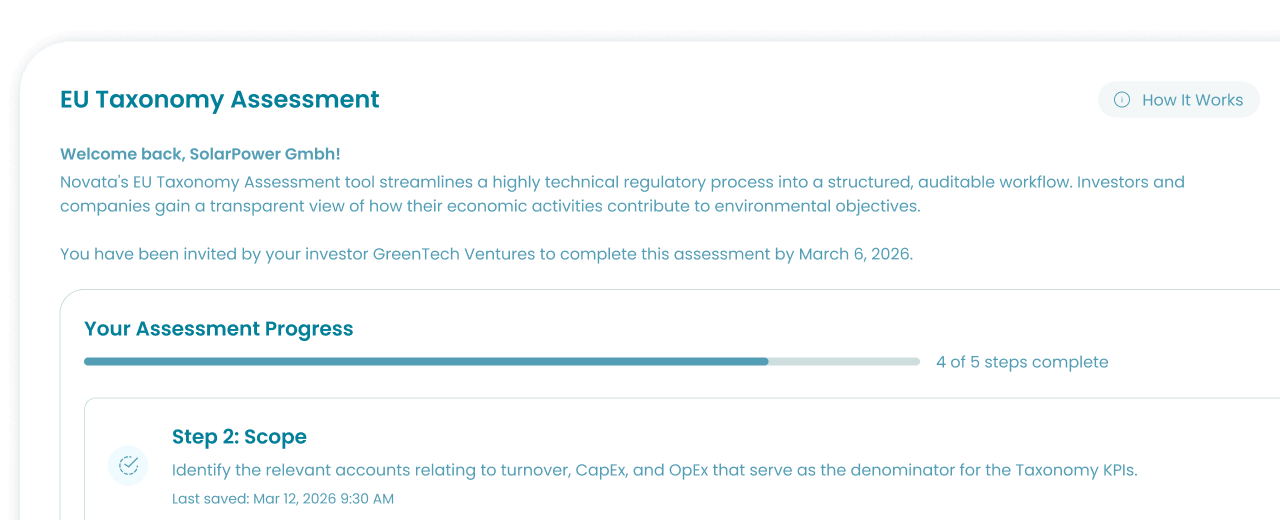
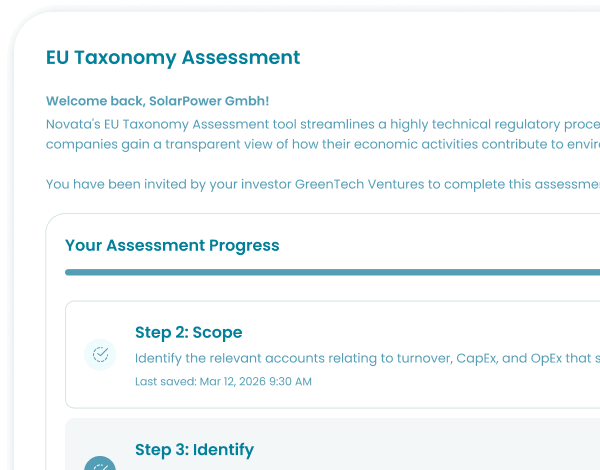
Track your assessment progress consistently with clear, auditable documentation. When it’s time to disclose, your data is organized, traceable, and ready.
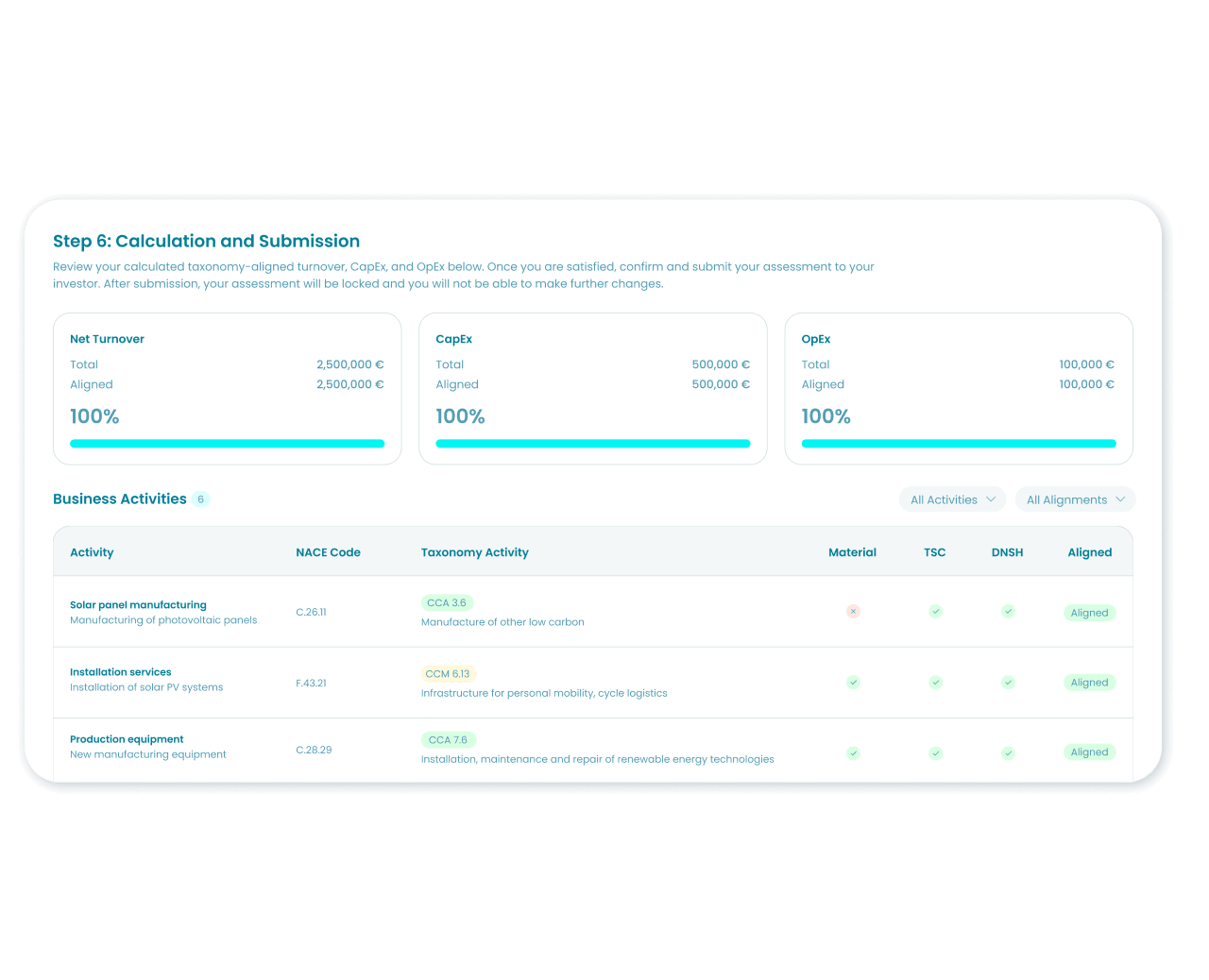
Novata delivers the numbers that matter: percentage alignment of turnover, CapEx, and OpEx; calculated at fund or company level, formatted for regulatory reporting, and ready to share with stakeholders.
EU Taxonomy disclosure is required if you fall under SFDR or CSRD.
SFDR Article 8 or Article 9 funds with a committed Taxonomy alignment percentage must disclose annually.
Businesses in scope for CSRD with eligible economic activities must calculate and disclose % alignment of turnover, CapEx, and OpEx.
Not sure if your activities are eligible? The EU Taxonomy regulation applies to specific sectors including energy, construction, manufacturing, transport, real estate, and forestry. Our EU Taxonomy tool is intuitive enough to be used as a self-service, but Novata Advisory is available if you need extra support.
Novata’s EU Taxonomy tool guides you through each step of the assessment process: from initial setup to final regulatory outputs.
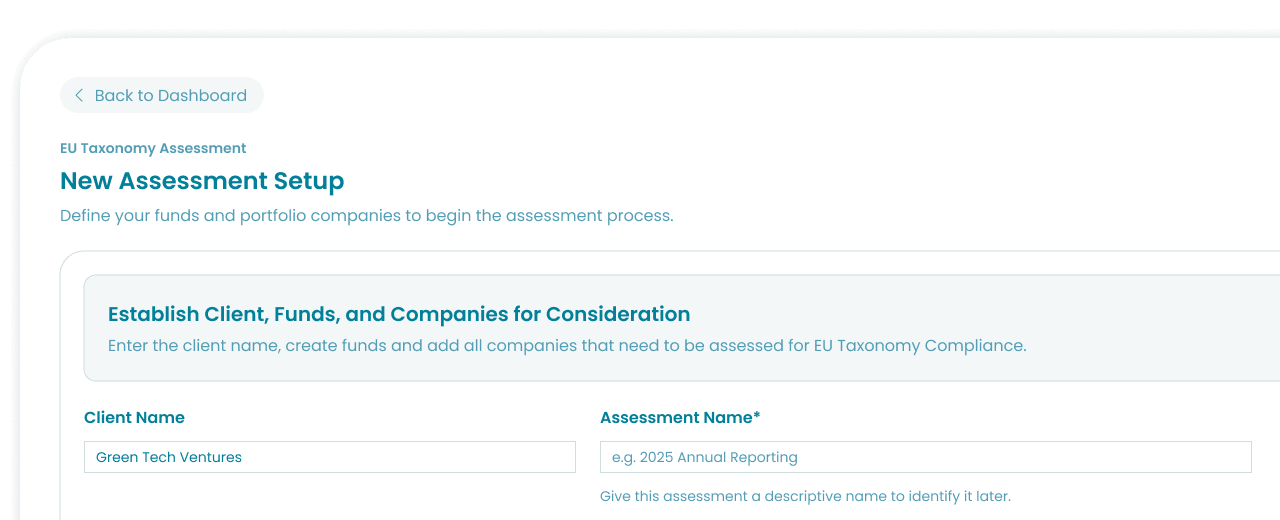
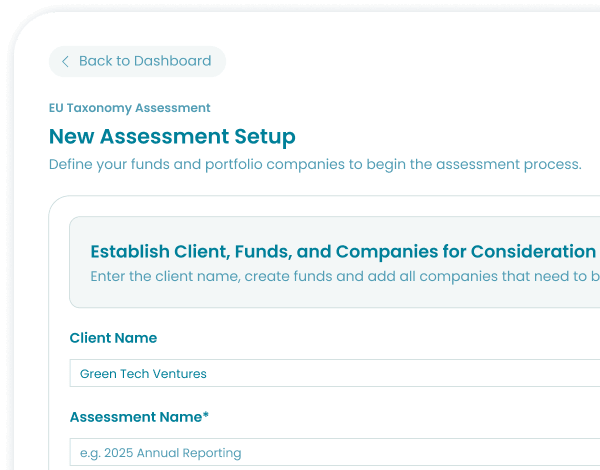
Set up your assessment by entering fund details, portfolio companies, country information, and contact emails. Once companies are invited, Novata's Invitation Tracker shows real-time status for every submission. Each touchpoint is logged for compliance documentation.
Portfolio companies enter their financial denominators (i.e., Turnover, CapEx, OpEx) which form the basis for all Taxonomy KPI calculations.
Companies define their business activities and map them to the relevant NACE codes. The tool guides users through the mapping process. Activities are matched against EU Taxonomy categories to determine which are eligible for a full alignment assessment.
Companies evaluate their eligible activities against the EU Taxonomy's Technical Screening Criteria (TSC), Do No Significant Harm (DNSH) requirements, and Minimum Social Safeguards, with structured, guided questions at each stage.
Calculate Taxonomy alignment across your portfolio and automatically generate regulator-ready outputs—Template I (fund-level KPIs), Template II (activity-level breakdowns), and Periodic Disclosure graphics—for both regulatory filings and stakeholder reporting.
The EU Taxonomy is a classification system that defines which economic activities can be considered environmentally sustainable. It establishes technical criteria for six environmental objectives — from climate change mitigation to biodiversity — and requires companies and investors to calculate and disclose the percentage of their activities that are “aligned.”
Companies subject to EU Taxonomy reporting requirements under the CSRD must disclose the proportion of their activities that are Taxonomy-eligible and Taxonomy-aligned. Non-financial companies report against turnover, CapEx and OpEx, subject to applicable materiality thresholds and simplifications, while financial institutions report sector-specific KPIs.
Separately, financial market participants offering financial products under SFDR Article 8 or Article 9 that promote environmental characteristics or have environmental objectives must disclose the extent to which their investments are aligned with the EU Taxonomy, where applicable.
The EU Taxonomy focuses on specific sectors with the most potential for environmental impact, including: energy, manufacturing, construction and real estate, transportation and storage, water and waste management, forestry, information and communication technology, professional and scientific activities, circular economy services, financial and insurance services, and select others. General IT, retail, hospitality, and most professional services are typically not eligible.
Eligibility means an economic activity falls within the EU Taxonomy framework. Alignment means the activity also meets the Technical Screening Criteria, makes a substantial contribution to an environmental objective, satisfies the Do No Significant Harm principle, and meets minimum social safeguards.
Assessment timelines vary by portfolio size and activity complexity, but Novata’s structured workflow and automated company invitation process significantly reduce the time and coordination burden compared to traditional consultant-led approaches.
Novata’s EU Taxonomy tool is intuitive enough to be used as a self-service. Our sustainability experts in Novata Advisory are available if you need extra support.
Whether you’re completing your first assessment or replacing a costly consultant engagement, Novata gives you the structure, tools, and expert support to get it done right.
Complete the form to learn more.