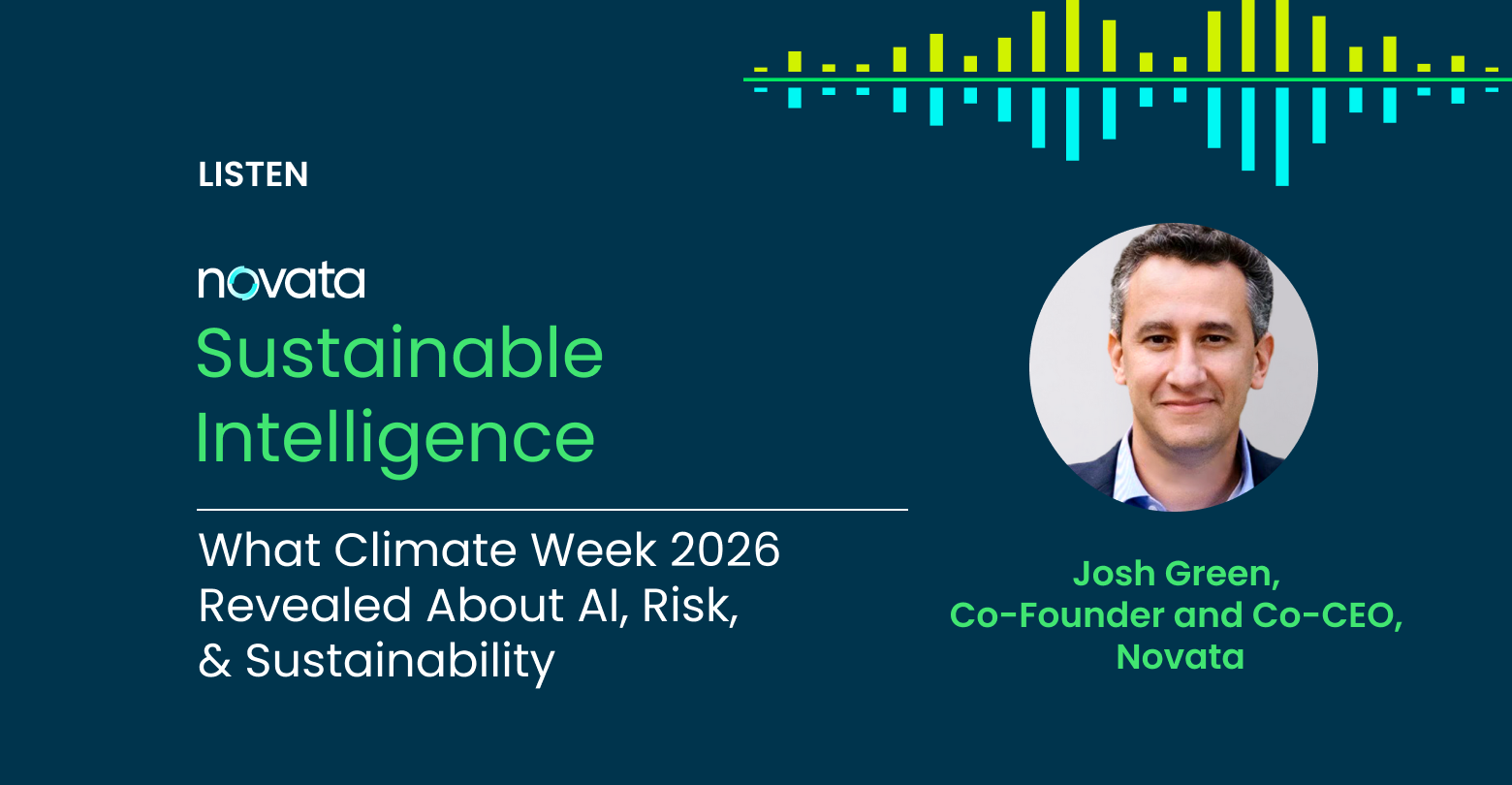
Joining us today is Colin Finn, Director of Customer Engagement at Novata. In this episode, Colin shares practical strategies for streamlining sustainability reporting in private markets. As sustainability teams face mounting reporting demands and regulatory changes, Colin breaks down how firms can prioritize data requests, centralize workflows, and leverage technology to make sustainability reporting more efficient and impactful.
About Sustainable Intelligence
Novata’s Sustainable Intelligence podcast brings honest, forward-thinking conversations about sustainability in the private markets. From carbon accounting to turning data into impact, each episode explores how investors and business leaders are tackling real challenges, meeting rising regulations, and building long-term value. Join us for expert insights, practical strategies, and authentic dialogue that empower action and progress in the evolving sustainability landscape. Listen to more episodes on Spotify or Apple Podcasts.
Conversation with Colin Finn (Transcript)
Ella Williamson: Welcome to Sustainable Intelligence, where we discuss all things sustainability for the private markets, brought to you by Novata. I’m Ella Williamson, and I’m thrilled to be your host.
Joining us today is Colin Finn, Director of Customer Engagement at Novata. With extensive experience across private equity, fund of funds, and venture strategies, Colin specializes in designing efficient sustainability data collection frameworks. His background in nonprofit fundraising, education, and hospitality gives him a unique approach to stakeholder engagement. As the leader of Novata’s global onboarding team, he helps investors and their portfolio companies streamline sustainability reporting. Right now, reporting season is in full swing, and for so many sustainability teams, that means tight deadlines and mounting data challenges. In this episode, we’ll break down practical strategies to tackle reporting demands, streamline workflows, and turn sustainability data into a powerful tool to build business resilience.
So Colin, let’s dive in. From a GP perspective, we know that sustainability teams are often buried under a flood of reporting requests, so many requirements, how do you suggest that they prioritize without sacrificing on quality?
Colin Finn: Yeah, that’s true. They are juggling a number of requests. And the key to staying on top of all this and not compromising the quality or the actual compliance of it all is being able to prioritize, find common ground, and develop smart workflows. And this is how I think they can go about it.
And the first way of doing that is identifying common themes across these requests. By themes, really this boils down to overlapping data points. Sustainability data requests are not like snowflakes. They are generally very similar in my experience. Yes, there are ways in which it bends and varies from one GP to another, but when you start to look at these major reporting frameworks, GRI, SASB, TCFD, sustainability teams will find comfort in knowing that these are the sorts of material requests that they’ll be getting from all of their different investors.
You’ll want to categorize these requests by stakeholder and urgency. I’m not in a position to tell folks how to stack rank these things. But from my perspective, you’ll always want to start with any regulatory reporting that is required for your portfolio companies. You’ll want to prioritize these to avoid penalties. That is not surprising. Following this regulatory reporting of course, investor and LP requests, these are essential for maintaining trust and funding. Finally, there are the voluntary reporting that you think your portfolio should be doing. Nice to have, but, by no means should overshadow this mandatory reporting that we saw in the previous two categories.
Beyond this prioritization, you’ll want to have a single source of truth for this data. We want to be outside of spreadsheets. We are in such a fast-paced industry that doesn’t really allow for this data to be disaggregated. And whether that’s a sustainability software platform, you’ll want to ensure that all this data lives in one place so that you are not searching for this information in the nooks and crannies of your SharePoints, and that you are actually providing consistent data to all of these different requests that are coming in. And then finally, you’ll want to ensure that all of these requests are not just seen as that, just requests. It’s not a compliance burden, but rather, sustainability leaders, as they well know, really are beneficial insights that can actually drive business value through cost savings, risk mitigation, or improved investor relations.
Being able to publicize that and publicly state the benefits of all the data that’s coming out of these requests and all of the insights generated from these requests; this becomes particularly useful in being able to go beyond seeing these as just requests and turning it into something that’s a core part of a business.
Ella: Absolutely. And I think what we always say is you can’t manage what you don’t measure. And by leveraging existing data that you already have across the business, prioritizing which tasks are most important, and also making sure that you have some sort of tool to be able to aggregate all this data and use it year over year is so important. And I can imagine it’s even more important when it comes to sustainability regulations. With new requirements constantly coming into play, teams simply can’t afford to just react at the drop of a dice. What’s your advice on how they can stay ahead instead of always playing catch up?
Colin: Yeah, there are a few things, some of which, I will probably be repeating myself from what we were just discussing. Naturally, we would say leverage technology for real-time monitoring. There are ways to digest easily regulatory news, all of the updates that are coming out, it’s fast moving.
I started in this space about three years ago and I would’ve been naive to say that it’s the same then as it was now; it’s vastly different. There are ways to just set up automated alerts for any new regulations that are coming out and things that are relevant to your industry. The other thing that I would really highlight is you need to, as best as you can, keep your teams and your organizations updated on sustainability regulations as much as possible.
There should be ongoing sustainability training for compliance, legal, and naturally your sustainability teams and any other sort of affected parties. This is something we see a lot of our clients implementing at their investment levels and saying, this is something we see as a priority, and we want to be sure that those affected by sustainability regulation are in the know, that it’s anything like anti-money laundering trainings, security trainings. We’re seeing that sort of fall, the sustainability training, into the same sort of category as these things that a lot of us are used to doing for compliance reasons.
And then beyond that, one of the things we talk about at Novata a lot and giving you a peek behind the curtain is how important data security is to us. This is something my team works with a lot, given that we are handling client data all the time. We highlight the fact that our security practices are so strict and so advanced.
We see compliance in the sustainability realm as a similar thing in being able to make compliance a competitive advantage and not as a burden and use that compliance to build investor trust and market differentiation. It’s something that we have started to do with our data security.
It’s something that others can do with sustainability and I think grouping all of those things together and making it part of the company’s DNA, your team will start to be able to anticipate these changes faster. So I guess that’s where I would leave that.
Ella: Awesome. So focusing on data security but also making sure you stay flexible in your approach and treating compliance as an opportunity rather than a burden that so many see it as. And ultimately I think it’s about being proactive in how you go about this rather than just waiting for those regulations to, to come down the track.
And I can imagine that when those changes come into play, it’s about getting the right data at the right time. We know that collecting sustainability data from multiple teams can be a huge challenge. One practitioner that I spoke to the other day talked about sustainability teams being rows in an Excel spreadsheet and the rest of the organization being columns. So that ultimately having to work with so many different teams, with so many different requirements. What would you say are the best strategies for GPs to make sure this process is as accurate and as timely as possible?
Colin: Yeah. And unsurprisingly, I would say you need to have something in place to automate and streamline data collection. A centralized platform where this data lives year to year, quarter to quarter, whatever it might be, and one that ideally has API integrations built into it to reduce manual input.
Even if we narrow down to carbon specifically, you don’t just pull out three to four figures on your scope, one, two, and three emissions. There’s tens of thousands of rows of data that go into that, tens of thousands of rows of data that already exist. And you need to be able to leverage existing data to generate the output needed.
So if we think about utility bills and expense reports, all of those things exist in different systems. How do we sublimate that data into something that seemingly through magic, but not really, it’s emissions factors and advanced technology that turns that information into data on your organization’s carbon emissions. It is not about collecting everything imaginable under the sun.
Ella, your point earlier that sustainability teams are rows in an Excel sheet, whereas the sort of other functions that exist alongside it within an organization are the columns, that is, we see, a little fractured.
But if you have a consistent ESG champion within your portfolio companies, you’ll see that there’s a stronger sense of accountability. Sending out a request to a CFO who has 8 million things on their plate, we have seen people tend to struggle there, or it gets punted around or kicked around until you find that right ESG champion. And so find that person early and find them often across your investments. And the final bit of that, and I think it stems off of having a champion, go from this once a year exercise that someone says, oh yeah, my Novata report. You have to remember your password and there’s things like that.
But moving from a one-time annual reporting to tracking this data maybe regularly or with certain dashboards that, when annual reporting comes along, it is now easy to send that data off. What you have now is someone who’s invested and starts to see that sustainability metrics and terms exist beyond this once annual exercise and is actually part of regular, everyday business happenings.
Ella: Absolutely. So you need to find your sustainability champion within your portfolio companies, but also look at the data that you already have at your fingertips to make sure you are utilizing that and bringing it into all of your reporting needs. Now when it comes to sustainability, every practitioner knows that you need to get board buy-in for everything you do.
And that isn’t always easy, especially when budgets can be tight. So what’s the secret to make a compelling case in your experience?
Colin: Yeah, so it can be tough. I wouldn’t want to gloss over that. But I think it boils down to three things. This is risk mitigation and cost reduction. Sustainability can be new for some firms, some individuals. I did not have this idea of sustainability as risk mitigation prior to joining Novata.
It’s become painfully clear to me; it even feels silly that I hadn’t thought about that before. So being able to illustrate how tracking ESG data helps identify cost saving opportunities and mitigates compliance risks will always play in your favor when trying to develop buy-in. Being able to take the data that you do gather from these exercises or regular monitoring, being able to generate benchmarks off those and insights to demonstrate how sustainability efforts do generally indicate or lead to long-term business value and you’ll be able to make those connections in a much more seamless way.
The other bit is that every business at its core wants to grow and, I was speaking with our Head of US Sales the other day, and he said that as firms start to near that 10 billion a number they’re going to move to a different set of investors.
And those different sets of investors, oftentimes European LPs, and the expectation around what sustainability data is gathered, what considerations the firm has made in the realm of sustainability becomes particularly important. And we generally see that if you are positing sustainability data collection as a means toward firm growth, this generally plays well in terms of generating that buy-in.
Ultimately, sustainability shouldn’t be seen as a compliance checkbox. Rather it’s a strategic advantage that can drive financial benefits.
Ella: It’s about making that case compelling to whoever you’re trying to get buy-in from, and I think that’s really key to sustainability storytelling. We’ve discussed collaboration in quite a lot of detail here, but we also know that sustainability professionals can be at very different stages of their journey. Some just starting out, some having been in it for 10, 20 years. For those who are just getting started, or for those who have been in this space for a long time, what are some key pieces of advice you could share with us to set them on the path of success?
Colin: Yeah, that’s a great question. And we see firms across that spectrum that you just provided every day at Novata. I really like working specifically with people who are new to sustainability. I would suggest starting small. We have done the math on this before, and if you build a framework that is brand new to your investments and throw a hundred metrics at them, the engagement goes down, the data accuracy goes down. It turns into one of those compliance checkbox nightmares that we’re trying to avoid. You can start small. If you want to track the top 10 key sustainability metrics for the industries you’re invested in, by all means we encourage that.
Better yet, if you’re able to align with a standards organization like a GRI, like SASB, we see that as even better. You start small and you source from one of those standards. Start the data collection process early. Try not to do it at the start of the new year. This is something that it’ll get lost in the shuffle of everything else that’s going on.
Give it time to breathe. A lot of this data is still being tabulated and your window to accurate data collection becomes very small. So allow teams to catch up with all the other data that feeds into these sustainability metrics.
The other thing I would suggest is reaching out to your peers and seeing what they’re doing. Convergence is a big part of sustainability. We love to see standardization across our clients. And so for those who are new to sustainability, I would suggest those few things.
For people who are pros at this, they’ve been doing this for a few years, strip down your frameworks is one thing I would say. There is a lot of merit in the metrics that we see our clients uniquely asking their portfolio companies every day. And oftentimes we’re seeing that the difference that they’re creating between their investor-specific framework and that of their co-investor leads to a lot of strife and pain for portfolio companies.
We would love to align all of our clients’ frameworks if we could. We understand that would never happen. But there is an opportunity for convergence there. Again, you want to align sustainability efforts with core business strategies. If you have to look at a metric and really think, “why are we asking this?” It might not be one that persists in future years of reporting. The final thing, I would say is be a partner to your stakeholders and those who are actually providing this data. One of the best parts about my job is to see my team working in tandem with portfolio companies, with people who are going through this for the first time or the fifth time.
Everyone is going to develop different strengths to reporting this data, different patterns to reporting this data. But ultimately, while my team can support with the technical bits, with providing guidance on how to best collect this data, we do often see that having a GP’s involvement in this data collection, being able to be responsive and being able to clarify why a metric is being asked or how it’s going to be utilized in the future is ultimately extremely helpful. So there is this partnership bit that becomes particularly important. Whether you are new to this or whether you’re experienced. And so my key takeaway is that you’ll spend less time chasing individuals for this data, chasing them for this general engagement. And ultimately, once all of this data is collected, you want to show what it’s worth is.
Ella: Awesome. And bringing it back full circle. Obviously technology can help teams do this and achieve this, and what we like to say here at Novata is working smarter is much better than working harder. And that ultimately makes sustainability reporting more efficient and more impactful for every business.
Colin, thank you so much for sharing your expertise today. Your experience working with both investors and companies across the industry brings such valuable perspectives. My personal key takeaway from today is sustainability reporting is more than just compliance. It’s about using the data that you do collect and not focusing on constantly chasing that data to ensure that we embed it into every core business strategy, meaning that it can be used in a more meaningful way. Until next time, let’s keep building sustainable intelligence together. Find out more at novata.com.