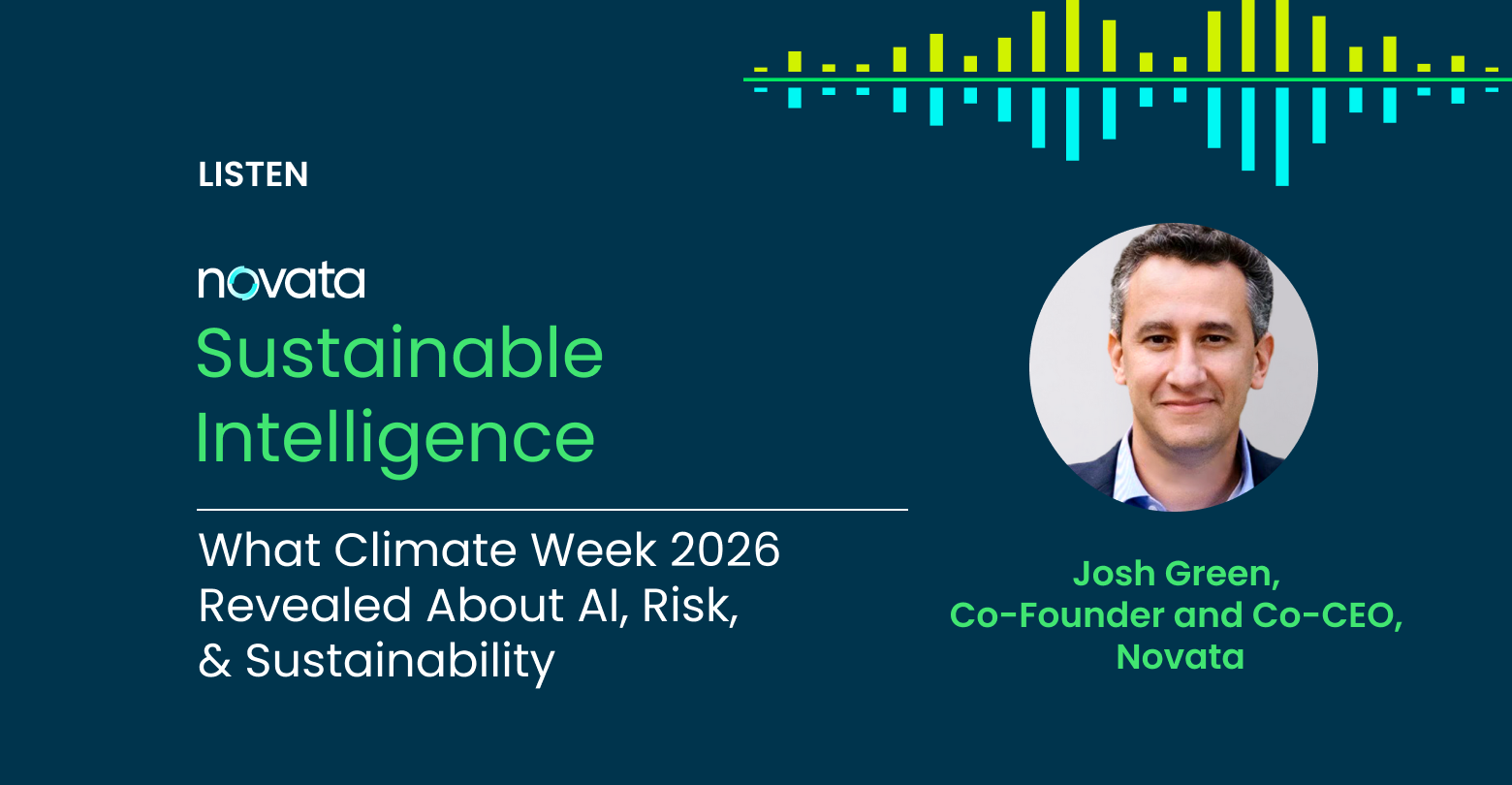
About Sustainable Intelligence
To celebrate Novata’s fifth anniversary, this special episode of the Sustainable Intelligence podcast brings together “voicemail”-style reflections from Novatans across the company, alongside a conversation with our Co-CEOs and Co-Founders, Alex Friedman and Josh Green. Through personal stories, memorable moments, and lessons learned, we look back on the milestones that have shaped the past five years and share our vision for what’s ahead.
Novata’s Sustainable Intelligence podcast brings honest, forward-thinking conversations about sustainability in the private markets. From carbon accounting to turning data into impact, each episode explores how investors and business leaders are tackling real challenges, meeting rising regulations, and building long-term value. Join us for expert insights, practical strategies, and authentic dialogue that empower action and progress in the evolving sustainability landscape. Listen to more episodes on Spotify or Apple Podcasts.
Conversation with Novatans (Transcript)
Josh Green: Welcome to a very special episode of Sustainable Intelligence. This month marks five years since the founding of Novata, and instead of our typical interview, we wanted to take a moment to reflect on the journey so far. I’m joined by Novata’s co-founder and co-CEO, Alex Friedman. And together, we thought we’d kick off today’s episode by looking back on where we started, what has surprised us along the way, and how both Novata and the sustainability landscape have evolved over the past five years.
After our conversation, you’ll hear from members of the Novata team, who’ve each played a role in building the company and shaping where we’re headed next. Alex, thanks for joining today.
Alex Friedman: It’s great to be here, Josh.
Josh: I wanna start at the beginning. So take us back before Novata had a name and it was just an idea. What problem did you believe needed solving when you first conceived of the idea?
Alex: The problem I thought needed solving was what is sustainability? How do you make sense of it? How do you tackle it? And where does a business even start? If we rewind the clock back to 2020 when we first started working on this, we knew the public markets were all over this topic of sustainability, but there seemed to be so many different ways companies were trying to tackle it and investors were trying to evaluate the results.
When we looked at the problem, we thought, how can we make it really simple, and how can we focus on private markets, not public markets? Because most of the world’s economic activity is focused on private markets, and that seemed to us to be the lever that had been ignored that could really potentially move the needle in terms of positive change.
But the problem was, how do we make it easy to figure out what metrics and information should be collected? How do you actually get that data? How do you have confidence in the results? How do you then figure out what to do with the data, whether it’s report to stakeholders, benchmark it, design improvement plans, all that kind of stuff?
Josh: And why do you think people had missed the private markets? Was it just a function of, things start with the biggest companies and start in the public markets, and then eventually people start paying attention to smaller companies and private markets? Was it just a matter of time, or was there something that was fundamentally missed, do you think?
Alex: It’s a really good question. My hypothesis is if you go back decades the public markets were a natural first mover in terms of pressure because you had lots of stakeholders who had megaphones and processes in corporate democracy where they could make their questions and demands heard.
In public companies, it’s been easy for a long time for shareholders to stand up and say, “What are you doing about this?” In private markets, two things made it more difficult.
One, private markets were a much smaller portion of overall capital markets until, frankly, very recently. Second, they’re private, so there weren’t those same shareholder dynamics at play. It really took an inflection point where private markets became a much bigger part of capital markets and the LP community became under its own pressure from its stakeholders, it’s your pension funds, sovereign funds, and others to say, “Hey, LP, what are you doing about the GPs you invest in, and what are they doing about those private companies when it comes to sustainability?”
Josh: One of the expressions that I’ve heard about timing is that when it comes to building companies, if you’re early, that’s just another way of saying you’re wrong.
And you got the timing exactly right. How did you know? What tipped you off that moment in time was a moment where it really was ripe to come in and deliver a solution?
Alex: Josh, you were there from the beginning, so you’ll have to weigh in on this too. My honest reaction is a lot of it was just luck in terms of the timing. When we started, as you will recall, I think we both felt a lot of pressure because we made a big announcement about what we were gonna do.
We got all these amazing partners together in a consortium, and we had no product ’cause we were building it. And we said to ourselves numerous times, “God, I wish we’d started this, a year earlier- … and we’d be on the cusp of this wave maybe a little bit faster.”
And as we look back, that wave has changed direction many times by now, right? So luck plays a big part of it.
Josh: Let’s go back to the early days. What do you remember from the earliest days and, what do you remember fondly?
Alex: I can think back to two or three things early on. First is we put together this amazing consortium of willing partners, right? This is the Ford Foundation, Hamilton Lane, S&P Global, Omidyar Network. That was amazing, and they took a big flyer on us.
We were just an idea with one or two people. Second thing we got really lucky on, you’ll be embarrassed for me to single you out is meeting you because you had all of the experience that we didn’t. You’d built a startup company. We came from a bigger organization. I look back and think, wow, we got so lucky. We found the right backers. We found the right partner, and as you point out, we got lucky on the timing too.
Josh: I remember in the earliest days, I swore that I’d never do another startup. And I remember, hearing your vision and initially having a reaction of some skepticism, thinking, boy, private markets, private equity, and sustainability sounds a little bit like oil and water. Not sure this is really a thing.
And then you very quickly introduced me to people in the ecosystem, and I learned no, it was really a thing that that this ecosystem was starting to get serious about sustainability, not because they were necessarily true believers in sustainability, but because the pressure was flowing downhill from the LPs down to the GPs and then ultimately to the companies.
And I remember working with you and the others at the outset, and then I think it was probably about six weeks in, I remember I woke up one morning and I thought, “I think I have a job.”
Alex: I think by that time I’d already told everyone you’d been working here for a while.
Josh: So was there a moment where you felt like, this thing’s working, and, we’re really onto something?
Alex: I distinctly remember I went with my family to see my parents. And between getting on the flight and landing, we passed 50 clients, and I thought, wow, 50 clients. That’s a real business.
Josh: Yep.
Alex: This thing is working. And that’s been the story since the beginning, right? Rollercoaster.
Which is why the cliches about what really matters is who you’re in the foxhole with have proven in my experience over the last five years to be so true.
There’s so many things we couldn’t predict. Some have been great, tailwind. We’ve been lucky, as I mentioned. Many of which headwinds, right? And so the question is how do we navigate it? And that always comes back to the same answer, which is who are you working with? Do you have confidence in them?
Do they have the strengths you don’t have? And is the team more than the sum of its parts?
Josh: So as you think back on the last five years a lot’s changed. What are the changes that you think have been most significant and/or, what was most unexpected in terms of change?
Alex: It won’t surprise you or anyone listening to this that in 2020, ’21, it felt like sustainability was a secular tailwind that would only move in one direction on a steep curve up. I don’t think I ever could have foreseen the political dynamics that evolved over the subsequent three or four years and that tailwind becoming a headwind in some parts of the world.
Other parts of the world historically seen as extractive petrostates that could care less about sustainability taking the mantle of leadership on it. Those kinds of things have surprised me for sure. The other thing that I found striking is how we as an organization have adapted to those dynamics.
I think back to our early discussions, do we need to do carbon accounting? Do we need to have strength on the east side? Seems so obvious now, right? Do we need to be strong in Europe? Do we need a presence there? Of course, in retrospect, but those were real questions we had to think through.
Same with APAC or the Middle East, right? And today, as we’ve developed over half a dozen distinct products that are knit together in integrated solutions, those are things I never would’ve conceived of five years ago.
Josh: That’s right. So is there something that comes to mind that you’re most proud of as you look back on the last five years?
Alex: What I’m most proud of is we face so many unexpected challenges, and we’ve tackled each one of them in the right way for the right reasons. Doesn’t mean we’ve always been right or that we’ve always nailed it, but I think we’ve stayed true to our value system.
We haven’t shied away from facing hard truths. And we’ve gotten more right than wrong. So I think about the next five years and it makes me super optimistic that we’ve got a good team that knows how to deal with really unexpected challenges, pivot effectively, do it without sacrificing our values and do it in a way that we take our stakeholders along with us.
We’ve had a great group of backers, a great board, great clients, and they’ve been with us from the beginning and they’re still with us. I’m really proud of that.
Josh: I run the risk of making you blush on this, but so much of this, Alex, is down to things that were there from day one because you set it up that way. I think the consortium was so well-conceived. I think the notion of structuring things as a partnership that really would empower the people who you brought into the organization. I think the insistence on having values be explicit and ground what we do and how we do it, I think all that was there from day one.
What I’m proud of is that those things are still shining through today but your foresight was really extraordinary.
Alex: Thank you. I appreciate that.
Scott Kennedy, who played a super important role in the design of the consortium, I think his long-term view on how to design something to last was very integral.
Josh: It’s a good reminder how many people were around the table in the early days. We had a great group of founders, Scott, Christina, Owen, and Margot from Ford Foundation.
Alex: KT.
Josh: KT. Certainly Doug and Martina from S&P and-
Alex: Eric Hirsch.
Josh: Eric Hirsch. It was an extraordinary group of people who were there, it was really amazing to see the thing move with authority once we got going.
All right, let’s look ahead. As you think about the next five years, what excites you the most?
Alex: You’ve heard me say this, but I look at the area we operate in, and I often think about the evolution of the capital markets, and I liken it to the period over the last five years feels like the period after the kind of crash of 1929 when all of a sudden there were all these new rules that were promulgated.
Different parts of the world did everything differently, and over the subsequent decades, the modern capital markets were formed and we had today what we take for granted, which is companies have to report information. They do it in a way that is consistent, has depth, there’s a lot of auditability to it, and there are all these groups that make sure the data’s good, and you can do things with the data, including S&P, our largest shareholder.
In our world of sustainability, we’re at the very beginning of this. We’re just starting to facilitate collecting information, let alone, as you point out, agreeing on what needs to be collected, let alone agreeing on what we can do with all that data, et cetera. So playing a role in that like we have over the first five years has been amazing, and I think we’re just so at the beginning.
So the next five years to me will be probably far more eventful than what we’ve already gone through, and it will go on for decades.
Josh: Two things come to mind for me. First, I do think we’ve been through a bit of a cleansing moment for the sustainability movement. The few years after we got started, we saw sustainability really take off.
There’s been a bit of a reckoning over the last year and a half where people who are serious about sustainability are being told to, to prove it, prove that this actually creates value.
And my sense is that we’re getting there. And as we get there, the foundation that we will have built for the next wave of sustainability work, is gonna be so much stronger than it was before. And I think that brings me to the second thing, you and I both very much had impact on our minds in choosing to do this with the next chapter of our careers.
And, I knew full well, and I know you did too, that a lot of companies start with big ambitions and hope to do things that result in positive change. But over time, reality sets in, and you end up having to narrow your focus and really focus on just making sure that the business survives.
One of the things that amazes me, though, about Novata is five years in, I’m more confident today than I was when we got started that this is a company that can have a real impact, and I’m so excited to see that play out in the years ahead.
Alex: So well put.
Josh: Anything that we didn’t hit that you wanna say?
Alex: I’d love to say thank you to everyone at Novata, because you and I, if it was just the two of us in a room, we’d be talking away and not much would happen. Thank you to our colleagues who are amazing and have allowed some of the vision we had at the beginning to become everything you just described.
Josh: It’s an extraordinary group of people, and I feel lucky to come into work every day and work with this team. And it’s the caliber of people that you surrounded yourself with from day one was extraordinary, but I think the team’s only gotten stronger and more impressive as the years have gone by.
And as we’ve learned about what we need to succeed, I think we’ve been able to continue to bring in amazing people. I would echo what you said, absolutely. Thank you to everybody who believed in this idea early and everybody who continues to believe and continues to put in the work.
Josh: Alex, thanks for taking a few minutes to reflect on the journey with me. I think we’d both agree that Novata wouldn’t be where it is today without the incredible people who’ve helped build it along the way. To celebrate our fifth anniversary, we asked colleagues from across the company to share their favorite memories, lessons learned, and hopes for the future.
Let’s hear what they had to say.
Jessie Miller: Hi, I’m Jesse Miller. I’m a Director on Novata’s advisory team. I’ve been with Novata now going on four years as of this fall. So it’s been a really amazing adventure seeing the company grow and evolve and continue to serve our clients and really have a strong role in the sustainability world of private markets.
One of my favorite memories is how the advisory team was actually developed and came to be the team that it is now. So when I initially joined Novata back in 2022, I was on the methodology team, which did a lot of great work around building on metric library, providing subject matter expertise on all things ESG and sustainability, and helping build out the platform and a lot of great features that we still have on the platform today.
But we didn’t have an advisory team. I think as Novata started serving more and more investor clients in the private market, we saw this need to help our clients better understand and leverage the data that they were getting out of the Novata platform.
And out of that need and demand we created the advisory team to basically provide that additional layer of expert support and services to our clients that they couldn’t just get from the platform alone. So being a founding member of the advisory team was such a great memory for me.
And then I think about today we’re split across the US and Europe and we’re continuing to serve our clients in new and innovative ways.
On the more personal and cultural side of Novata I’ve been really lucky to have been based out of our New York office and really get to know so many people across Novata’s departments and not just on my own team.
One of my other favorite memories, I remember a few years ago as part of the women’s ERG I planned and hosted a wine tasting in our New York office that featured wine from all woman-owned wineries or woman winemakers.
And it was really fun for me to take this personal passion that I have for wine and wine tasting and bring it to Novata and to get to share that with my colleagues. I love that about Novata. We’re always doing fun events. We’re always finding new activities for us to do. I feel like we’ve built a really strong, fun culture here.
Kyle Flick: Hi, I’m Kyle Flick and I’m Head of APAC at Novata.
So I was thinking about a couple of things. First, very much in the early days when we didn’t have a product and things were very unknowable. We’re sitting in the room. I think there was maybe 15 of us. We’re making the first version of the product, trying to get things in order, not knowing what the future is going to hold.
Are people gonna like this? Are they not gonna like this? It was just a very new and exciting time. But what I thought, from there, every time we go to new cities and launch in new cities where no one knows us, that’s been really exhilarating.
So a few examples I think of: early days going to the PEI conference in San Francisco, early days going to a Canadian conference in Vancouver, and Geneva in Switzerland, and then out to Singapore and Asia. And every single time, we’ve had to really start from zero.
And I think that’s a good way to think about what this journey’s been like. Every time we get new clients, every time the business grows, we feel like we know more, which can be true at times. But, the future is always unknowable, and I think going to these new cities really shows you that.
And to me, doing that and singing the Novata song in different ways to different people has always been really exciting for me.
Emily Sennett: I am Emily Sennett. I am the Head of our Customer Success team.
When I think about my four years at Novata, I think the people for sure stand out the most. I am a remote employee based out of North Carolina, but I think I have the pleasure of traveling, visiting my friends and family all over the globe, and when I do, I get to meet up with other Novata colleagues as well.
I’ve done drinks with people in Atlanta. I’ve gone to Denver and met up with folks for coffee. I’ve done our Novata run club across the Thames River in London with our coworkers there. I obviously have lunch with everybody at the Novata lunch table in New York when I’m in town. So it’s been really nice to meet people out of a Zoom box and see folks not just on Slack, but in person in their hometowns and in their areas.
When folks come to North Carolina, I always welcome them, and we go out to dinner, and I show them around my area as well.
From my last four years at Novata from a customer perspective, I really think about our initial clients.
I think they were the ones who opened my eyes to understanding what the private markets’ ecosystem is really and how valuable Novata can be to be a player in that ecosystem. When we first started, it was just me. We actually had one client when I joined and no product yet, but myself and another onboarder who’s now our team lead in the US, we were a client success team for our clients.
And one of our first clients was such a good example of showing us the private markets ecosystem over the years. They started just basic data collection, and then they actually had a pretty complex carbon use case, which we didn’t have on the platform at the time, but we were able to have them join and start using the Carbon Navigator once we launched that product, and then we also saw them become a client for our LPs. And then even further throughout the years they’ve had some portfolio companies interested in using Novata themselves for their own sustainability initiatives.
So it wasn’t overnight, but it was cool to see them become one of our first clients to them using different parts of the platform over the past four and a half years and expanding their use case with us. And so we started with one or two clients and now we have over four hundred clients.
Our CS team is over twenty in five different time zones. So It’s really been nice to see that expand across the four to five years that I’ve been here.
Teresa Yu: Hi, my name is Teresa Yu, and I’m the Head of Metrics and Regulations.
The biggest lesson for me as a recovering perfectionist is, and it’s a great metaphor for sustainability at large, is that perfect is the enemy of good. It sounds very cliché, but it’s very real. I think from the metrics and regulations standpoint, there’s a lot of pressure, instinct to wait for the definitive answer, the final metric, the final framework, the very clear, concise definition before putting anything out.
I think that is a critique that we hear about sustainability reporting, about frameworks, and a big lesson has been to roll with the punches. It’s that change is inevitable.
We want regulations and standards to keep moving. We want the goalpost to shift every year because it means that the industry, companies are improving. I think a great example of this is with the natural evolution of carbon accounting. Ten years ago just collecting your emissions inventory was a high and tall order for many companies.
Nowadays, it’s table stakes. Nowadays, we’re even getting more granular within Scope 2, market-based, location-based. We’re getting really in the weeds with Scope 3 into the fifteen categories. Change is natural, and I think something I’ve really learned to embrace at Novata is to embrace that change.
There is a natural evolution that comes with regulations, and it’s reflective of how private markets are evolving. I think what is important is to stay constant with your North Star, whatever that is.
There will be lots of risks, geopolitical risks, supply chain risks, climate risks. Staying true to your priorities, your sustainability strategy, and remaining relentless in your commitment, that’s really where the strength is with sustainability.
Alfie Bullmore: Hello, my name is Alfie. I’m a Senior Software Engineer here at Novata. I’ve been here since November 2022, and I’m looking at the big lesson I’ve learned while I’ve been here. Probably the biggest positive I’ve learned here, essentially the power of flexibility.
There’s a couple of examples that spring to mind. The first one that’s probably the most pressing at the moment is we used to be one team, and then we split into companies and investors as we saw two different paths for two different use cases.
And then now we come all the way back, and we’re together again as team revenue. And I don’t think that’s an indication that we made the wrong decision back then. I think it was quite powerful that Novata was able to adapt so quickly to what we thought the market was doing.
And there was another one as well, probably in a way, my favorite thing I’ve worked on at Novata was this thing we did about a year ago called Custom Reports.
And custom reporting essentially included all these new innovative features like autofill, early form of internal reporting and metric mapping. And I thought this was going to change how Novata collected data. I thought this was going to be the future. And then we released it, and no one used it.
And the people that did use it, used it in a way that we really weren’t expecting, and they got tripped up on it the whole time. And I remember feeling quite down about it ’cause we’d put in a lot of work, and there was a lot of hype around this. But it didn’t matter because all of those features we cannibalized and we used. And then they’re now key parts of either the reporting flow for autofill, the metric mapping flow.
Incorporating that into AI, and that’s now becoming a big thing for limited partners. So this whole thing that initially felt like it hadn’t quite worked out, I was impressed with Novata and our flexibility about not taking it as a loss and redoing it and remaking it and being fluid and as flexible as possible.
Di Zhao: Hello, my name is Di Zhao, and I’m on the sales team at Novata. The portfolio company sustainability journey is what I’m most excited for over the next few years. When Novata first started, portcos reported because GPs needed data. Most of them were just along for the ride and new to sustainability reporting. Most companies were just checking the box. And now something’s changed where portcos are taking sustainability measurement into their own hands and doing more than the bare minimum that their GPs initially asked for.
And this could be because customers want more data, their own value creations want more data, and state regulators want more data. But in any case, they are coming to Novata directly themselves with no GP involved at all in recent cases, and this is so exciting to me because most of the world’s jobs and revenue flow through private companies like these.
And I’m excited to be alive during a time when companies are building sustainability into how they run a business, not because they have to, but because they want to, because they can see the impact that it makes.
Greg Taylor: Hi, I’m Greg Taylor, Senior Account Executive for EMEA at Novata. It’s a pleasure to be here today discussing these topics.
I choose to be optimistic about the future. And there are three key areas within the space of ESG, data, risk, sustainability that does excite me for the future. But number one what we’ve seen in the world of, the acronym of ESG is that it hasn’t been as popular as it has been in the past.
And from my perspective, having been in the industry for a few years now, I actually see it as more of a positive thing because we are moving from a world where everything is about box ticking and compliance into this place of actually data is something that you don’t just report to, it becomes something that’s actually important.
The second point that I’m super excited about of course, is artificial intelligence. I think it levels the playing field for a lot of companies.
So for example, a small company can get all sorts of different insight from their data that they might not have been able to afford, at a previous point in time with consultants and all sorts of other, tools and so on. AI is leveling the playing field a little bit.
Yes, there are some other challenges around energy when it comes to AI. Of course, it’s a big energy race now and I think that’s a huge drain on the planet, but I’m really hoping that we can come out the other side better, stronger than what we did when we went in.
The third thing I’m most excited about, especially at Novata and what we’re doing, is around resilience.
I think resilience in a volatile geopolitical landscape, resilience in terms of the climate shocks that I’m experiencing sitting here in the UK, for example. Having a more resilient business through this understanding the data, right? Linking it out into your supply chain, your value chain, means that you can begin to see around the corners of what may be coming your way.
And I think that now more than ever is so incredibly important. So in summary, I’m excited about this move towards a more inclusive, sustainable form of capitalism that we’re all, at Novata to achieve. And so I think the next five years will see us take huge strides towards that.
Josh: To everyone who shared their reflections and to everyone who has been part of Novata’s journey over the past five years, thank you. We are incredibly proud of what we’ve built together and even more excited about what’s ahead. Until next time, let’s keep building sustainable intelligence together. As always, you can find out more about Novata at Novata.com.