
Before an organization can develop a meaningful sustainability strategy, it needs to understand what matters most. Which sustainability issues create the most significant impacts? Which could create meaningful risks or opportunities for the business? Where should management focus its attention, investment and resources?
A double materiality assessment (DMA) provides a structured way to answer these questions. Double materiality considers sustainability from two connected perspectives:
- Impact materiality: How the organization affects people and the environment.
- Financial materiality: How sustainability-related risks and opportunities could affect the organization financially.
A sustainability matter can be material from either perspective, or both.
By identifying and prioritizing an organization’s most significant impacts, risks and opportunities (IROs), a DMA creates an evidence-based foundation for deciding what the organization’s sustainability strategy should focus on.
The results can inform strategic priorities, objectives, actions, KPIs and targets, governance, risk management and sustainability data collection.
For organizations subject to the Corporate Sustainability Reporting Directive (CSRD), double materiality also has a specific regulatory purpose: it determines which sustainability matters and related information need to be reported under the European Sustainability Reporting Standards (ESRS).
But its usefulness extends beyond compliance. Organizations can use double materiality voluntarily to create the foundations for a focused, proportionate and business-relevant sustainability strategy. This guide explains how double materiality works, how it differs from single materiality, and how to build a practical, well-documented assessment.
Impact Materiality vs. Financial Materiality
Double materiality combines two distinct perspectives. Impact materiality is the “inside-out” view: how the organization’s activities affect the world around it. Financial materiality is the “outside-in” view: how sustainability-related issues affect the organization financially. A double material assessment gives a company a complete picture of its sustainability risks and opportunities.
The two perspectives ask different questions, use different assessment criteria, and serve different information needs. However, both are connected: An impact related to emissions, water use, or labor conditions in the supply chain may become a financial risk over time as regulation tightens, input costs rise, or customers and investors respond.
| Impact materiality | Financial materiality | |
|---|---|---|
| Perspective | Inside-out | Outside-in |
| Core question | How does the organization affect people and the environment? | How do sustainability issues affect the organization’s financial performance? |
| What is assessed | Actual and potential, positive and negative impacts | Sustainability-related risks and opportunities |
| Examples |
|
|
| Who it serves | Society, stakeholders, and regulators | Investors and capital providers |
Single Materiality vs. Double Materiality
Single materiality generally considers the effects of sustainability issues through one perspective. In investor-focused reporting, this often means financial materiality: how sustainability-related risks and opportunities affect enterprise value or financial outcomes. The International Sustainability Standards Board (ISSB) standards, IFRS S1 and S2, use this investor-focused perspective.
Impact materiality, the lens at the core of the GRI Standards, looks at an organization’s impacts on the economy, environment, and people.
Double materiality, required by the CSRD, combines the two. It asks:
- How does the organization affect people and the environment?
- How do sustainability-related issues affect the organization financially?
Understanding the distinction matters for organizations using more than one framework. A DMA can support a broader sustainability data strategy, but it does not automatically satisfy every disclosure requirement under another standard or regulation. The required disclosures, definitions, boundaries, and reporting objectives still need to be reviewed separately.
The distinction is also important because the approaches can produce different conclusions about which sustainability issues are material. Organizations reporting under both CSRD and ISSB standards need to understand how the two relate. See our guide to ESG standards and frameworks for more information.
Why Does Double Materiality Matter?
For organizations in scope of CSRD reporting, double materiality is the mandatory starting point for determining which sustainability topics and ESRS disclosures are relevant. It therefore influences the scope of the sustainability statement and the data, policies, actions, metrics, and targets that support it.
The value of the process extends beyond compliance. A well-designed assessment can help an organization:
- Focus data collection on information that supports decisions and reporting
- Connect sustainability matters to strategy, risk management, and financial planning
- Identify where impacts, risks, and opportunities are concentrated across the value chain
- Clarify ownership of sustainability information and decisions
- Create a documented rationale that can be reviewed internally and externally
- Compare priorities across business units, portfolio companies, or geographies
The result should not be a static list of topics. It should be a clear view of what matters, why it matters, who is affected, how the organization is responding, and what information is needed to monitor progress.
Simplify Your Double Materiality Assessment
Novata’s step-by-step solution provides the structure, tools, and guidance to define your business context, identify relevant IROs, assess materiality, and connect material topics to ESRS data points.
Double Materiality as the Foundation of Sustainability Strategy
A DMA is not a sustainability strategy. It is the diagnostic that should come before one. A sustainability strategy determines what an organization intends to prioritize and achieve, while A DMA provides the evidence needed to make those decisions.
The relationship can be thought of as:
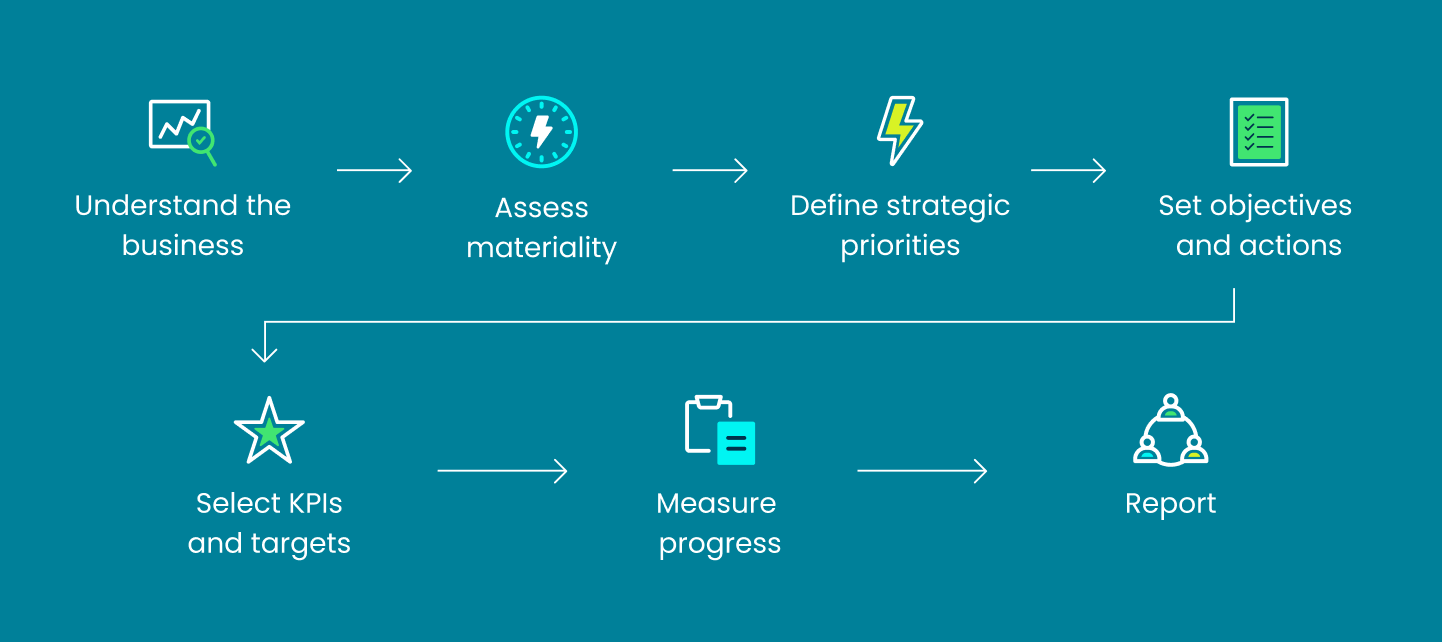
Once material sustainability matters have been identified, organizations can use them to determine:
- Strategic priorities: Which sustainability matters require management attention?
- Objectives: What does the organization want to achieve in relation to those priorities?
- Actions: What policies, initiatives or operational changes are required?
- KPIs and targets: How will the organization measure whether it is making progress?
- Governance: Who should own and oversee each priority?
- Data: What information needs to be collected and monitored?
- Risk management: Which sustainability risks and opportunities should be incorporated into wider enterprise risk processes?
- Reporting: What information should be communicated to investors, customers, employees, regulators and other stakeholders?
This sequencing helps organizations avoid trying to measure everything. Instead, sustainability data collection and reporting can be built around the issues that have first been identified as significant.
For organizations at an earlier stage of their sustainability journey, this is particularly valuable. A comprehensive sustainability strategy does not need to exist before conducting a DMA (or at least, a financial materiality assessment). The assessment can instead provide the foundation from which that strategy is developed.
What Are IROs?
IROs (impacts, risks, and opportunities) are the core units of analysis in a double materiality assessment.
- Impacts are the actual or potential positive or negative effects an organization has on people or the environment. They can be connected to the organization’s own operations or to its upstream and downstream value chain.
- Risks are sustainability-related uncertainties that could affect the organization’s financial position, performance, cash flows, access to finance, or cost of capital.
- Opportunities are sustainability-related possibilities that could create positive financial effects for the organization.
A single topic usually generates several IROs at once. Climate change, for example, might involve an impact related to the organization’s emissions, a risk related to carbon pricing, and an opportunity related to the growing demand for lower-carbon products.
Identifying and assessing IROs across the relevant sustainability topics is the real work of a DMA. Recording these relationships helps teams move from a high-level materiality discussion to a traceable assessment that can inform reporting and business decisions.
How to Conduct a Double Materiality Assessment
The CSRD does not prescribe a single detailed method for conducting a double materiality assessment. The process varies by company size, industry, locations, business relationships, stakeholders, and internal processes. Typically, a robust DMA follows a clear sequence:
- Understand the business context. Map the organization’s business model, activities, products and services, operations, financial position, and upstream and downstream value chain. Identify the stakeholders affected by, and interested in, its business activities. Strategy documents, financial statements, and a value-chain map are key inputs to help establish this foundation.
- Identify potential IROs. Develop a comprehensive list of potential IROs by reviewing relevant ESRS topical requirements (the standardized set of environmental, social, and governance topics), industry and company-specific considerations, and other relevant standards or frameworks. Due diligence, stakeholder engagement, grievance mechanisms, risk management processes, and existing sustainability information can also inform the assessment. For each IRO, record whether it relates to the organization’s own operations, its upstream or downstream value chain, and the relevant time horizon.
- Assess and determine material IROs. Evaluate the severity and likelihood of current and potential impacts, and the likelihood and potential financial magnitude of risks and opportunities across relevant time horizons. Apply consistent, evidence-based thresholds to determine whether each IRO is material from the impact perspective, the financial perspective, or both. A materiality matrix can help communicate the results, but it should support the underlying assessment and rationale.
- Identify information to be reported and explain the outcome. Use the final list of material IROs to determine which sustainability information should be reported. Map material IROs to the relevant ESRS topics, disclosure requirements, and data points, and document why each matter was included or excluded. The organization must also explain the process it used to identify, assess, and determine material IROs, including its methodology, thresholds, stakeholder engagement, and key judgments, as required under ESRS 2 IRO-1, IRO-2, and SBM-3.
Common Challenges of a Double Materiality Assessment
Because impact and financial materiality are equally valid routes to materiality, a weak assessment of either perspective can affect the quality of the whole report.
Incomplete value-chain information
Organizations may not have consistent, reliable information across suppliers, customers, and other business relationships. Begin with the information reasonably available, use credible sector or regional information where appropriate, and record data limitations and assumptions. Improve the evidence base over time rather than delaying the assessment indefinitely.
Inconsistent scoring and thresholds
Different teams may interpret severity, likelihood, or financial magnitude differently. Define the criteria before scoring, provide practical guidance, and retain the rationale for significant judgments. Consistency and transparency are more useful than a false appearance of precision.
Limited stakeholder engagement
Stakeholder engagement can become a formality if it is disconnected from the IRO assessment. Link each engagement activity to a clear question, document who was consulted, and show how the input affected the assessment—or explain why it did not.
Fragmented ownership and evidence
Sustainability information often sits across finance, risk, procurement, human resources, operations, legal, and investor relations. Establish owners for each IRO and related disclosure, maintain supporting evidence, and create a version-controlled record of decisions.
Treating the DMA as a reporting exercise
One of the biggest missed opportunities is completing a materiality assessment, producing a matrix and then filing the results away until the next reporting cycle. Material findings should feed into strategy, risk management, governance, KPIs and business planning. That is what turns materiality assessment into useful management information.
Double Materiality and CSRD Reporting
For organizations in scope of CSRD, double materiality is the basis for determining material sustainability information under ESRS. The assessment helps identify the material impacts, risks, and opportunities that shape the sustainability statement and the disclosures connected to them.
However, EU changes in 2026 have affected CSRD scope and timelines, and ESRS-related updates have also introduced more proportionate approaches, including top-down assessment where materiality is clear from the organization’s context. Whether an organization is in scope, when it must report, and which provisions apply can depend on the latest EU rules, national implementation, company characteristics, and available reliefs.
Organizations should confirm their position with qualified legal or regulatory advisers and consult current official guidance. For organizations that are in scope, the practical priority is to maintain a defensible connection between business context, IROs, stakeholder input, materiality conclusions, disclosure requirements, and supporting data.
What Does Double Materiality Mean for Investors?
Double materiality can also provide private-market investors with a more structured way to understand sustainability priorities across their portfolios.
At the firm level, an investor can assess the sustainability impacts connected to its activities alongside sustainability-related risks and opportunities affecting the business.
At portfolio level, investors can support portfolio companies in identifying their individual material sustainability matters.
This can help investors:
- Identify where sustainability impacts and financial exposures are concentrated
- Understand differences in sustainability priorities between portfolio companies
- Tailor data requests around issues that are genuinely relevant
- Support portfolio companies in developing sustainability strategies and action plans
- Strengthen sustainability-related risk management
- Inform engagement and value-creation priorities
- Support portfolio companies subject to applicable sustainability reporting requirements
A consistent materiality methodology can therefore provide common structure across a portfolio without assuming that every company should have the same sustainability priorities. This is particularly important in diversified portfolios where business models, sectors, geographies and sustainability exposures differ substantially.
When done well, this approach turns a compliance requirement into a sharper view of where sustainability risk and values it across the portfolio.
How Novata Can Help
Novata turns the assessment from a spreadsheet exercise into a structured, audit-ready workflow. With Novata’s platform and expert advisory support, teams can structure the DMA process, document business context, identify and assess IROs, engage relevant stakeholders, and maintain a clear record of materiality decisions. Our advisory team supports the process end to end.
Frequently asked questions
Double materiality is the principle that an organization assesses sustainability from two perspectives: its impacts on people and the environment (impact materiality), and how sustainability issues affect its own finances (financial materiality). A topic is material, and reportable, if it meets either perspective.
Impact materiality is the inside-out view: how your activities affect people and the environment. Financial materiality is the outside-in view: how sustainability issues affect your financial performance.
Single materiality assesses sustainability through one perspective, often financial materiality in investor-focused reporting. Double materiality combines financial materiality with impact materiality. For example, single materiality asks how climate change affects you but double materiality also asks how you affect the climate.
Organizations subject to applicable CSRD and ESRS requirements need to determine their material sustainability information using the double materiality principle. Scope, timing, and detailed requirements have changed as EU rules have evolved, so organizations should confirm which requirements apply to them under the latest rules and national implementation. Other organizations may conduct a DMA voluntarily to support strategy, risk management, stakeholder engagement, or customer and investor requirements.
IROs are the impacts, risks, and opportunities assessed in a double materiality assessment. Impacts relate to your effects on people and the environment; risks and opportunities relate to the financial effects of sustainability issues on your business. They are the core unit of analysis in a DMA.
Understand your business context, identify sustainability topics and IROs (starting from the ESRS list), engage stakeholders, then assess each topic for impact materiality and financial materiality. Set thresholds to decide what is material, and map the material topics to the relevant ESRS disclosures.
Companies in scope of the CSRD must conduct a DMA. Beyond that, many organizations run a DMA voluntarily because it sharpens strategy and risk management, stakeholder engagement, and sustainability data collection.
A DMA should be reviewed and updated when significant changes could affect the organization’s impacts, risks, opportunities, strategy, operations, or value chain. The applicable reporting requirements may also specify expectations for updating information.
A materiality matrix is a visual summary that plots sustainability topics by their significance from both the impact and financial perspectives. It helps companies prioritize and communicate which topics are material. It can help communicate the results, but it does not replace the underlying IRO assessment, evidence, judgments, and documentation.
Yes. An investment firm can assess the impacts, risks, and opportunities connected to its own business and portfolio. The process should reflect the firm’s activities, investment strategy, portfolio exposure, value chain, and relevant reporting obligations.
Turn Double Materiality into a Business Decision, Not a Burden
A double materiality assessment is most useful when it is connected to the decisions that follow: what to measure, who owns the work, which actions to prioritize, and how progress will be reported.
Novata’s platform and advisory experts help companies and investors run double materiality assessments—from identifying IROs to automatically mapping material topics to ESRS disclosures and preparing audit-ready documentation.